November 01, 2003
We have met the enemy.
Mobile Infrared Devices, or MIRTs, allow non-law-enforcement to arbitrarily control traffic lights. While this was an entertaining plot wrinkle in The Italian Job, it doesn't really scale for the antics of commuters.
4 November 2003 UPDATE: This is all over the news right now.
And the antics of a commuter stopped the Metro-North commuter railroad:
The man was on a suburban train from Grand Central Station on Wednesday night when he went to the bathroom to make a phone call, dropped the phone into the toilet bowl and then his hand and arm became stuck trying to retrieve it, officials said.
Metro-North Railroad staff could not help the man, so they stopped the train and called police officers and firefighters to extricate him, a process that took 90 minutes using "jaws of life" rescue equipment.
"The toilets are made of aluminum so I imagine he was down on hands and knees with his shirt rolled up and hand and arm down inside, trying to flush out his cell phone," said Jim Cameron of the Connecticut Metro-North commuter council.
You can build your own gyroscopic human transporter á la Segway or Ginger or the "IT" thing or whatever.
October 30, 2003
Give yourself a better life.
8 Nov 2003 UPDATE:
A similar report landed on the New York Times, this time in Manhattan. An 8'x10' vault on a plot in the East Village may be available, for an estimated quarter-million dollars.
San Francisco slowly moved all cemeteries out of the city boundaries; now the long-buried turn-of-the-(last)-century élite may have their earthly revenge.
It was the impermanence of permanence that gave rise to Mountain View in the first place. From the mid-19th century onward, San Francisco real estate was so desirable that it was difficult even to find permanent room for the departed."The dead kept getting kicked out of the city," said Gray Brechin, a historian who wrote "Imperial San Francisco: Urban Power, Earthy Ruin" (University of California Press, 1999). As cemeteries were cleared for development, the well-to-do realized that nothing was secure. They chose Oakland for their eternal resting spot.
I have long wanted to write a story about the City of the Dead.
Burning autos give you so much more.
Saw a car burst into flames this morning.
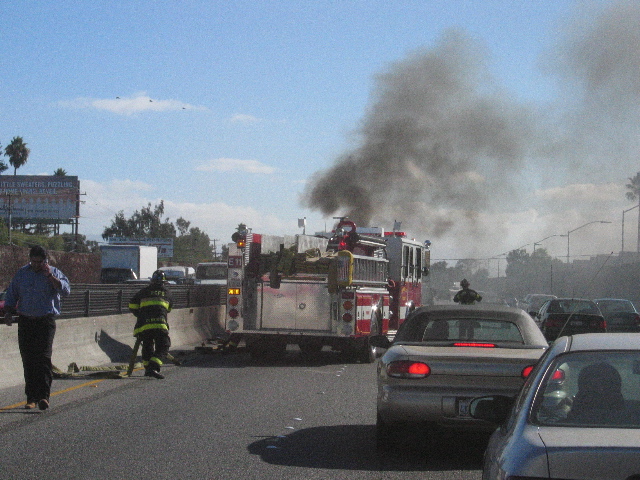
Just north of the Marsh Road exit on 101, in the Number 4 lane southbound. At first a thin white smoke we sighted, about 3/4 mi ahead; as we drew closer (and were passed by a fire engine), the smoke turned to a thick, dark grey. The heat from the burning vehicle was intense even two lanes away.
October 28, 2003
The light at the end of the tunnel.
Today marks the final instalment of Randy Kennedy's excellent Tunnel Vision column.
A few years ago, MTv Press published Keith Lowe's deft novel with the same name. Lowe tells the story of a young trainspotter-in-denial who, on the eve of his honeymoon, makes a silly bet with a fellow punter: his honeymoon tickets (on the Eurostar, natch) for the punter's collection of tickets. The terms: the groom must ride the Tube, through every station. Such a thing has never been done before!
October 26, 2003
I choo-choo-choose you!
Drove out to the open studios at Hunters Point, once a naval base and the largest drydock on the West Coast and now a thriving artist's community.
Plans for redevelopment are underway, despite the presence of various toxic chemicals in the ground and the adjacent decrepit power plant.
Wondering whether a Superfund site can be Superfun? The Golden Gate Railroad Museum sure is! With the aid of a rambling raconteur who "caught the bug from her son", we explored the 4-6-2 steam locomotive, Union Pacific Number 2472.
UPDATE: The New York Times have an excellent editorial on the almost-exhausted trust money for Superfund.
Afterwards I continued my search for tortilla chips with a sojourn out to the outer outer parts of Ocean View, where Botana makes its new home. Happily fed, drove thither to a remarkably clear view from the heights of Twin Peaks. I can't think that I've ever seen so clearly from the top of that hill, and certainly never at night.
October 28, 2003
Superfund Undermined
The industry-financed trust fund that helps underwrite one of the country's most valued environmental programs, the Superfund, will soon run out of money. It will be a milestone of sorts, and a sad one. Unless Congress renews the fund, which pays for cleaning up toxic waste dumps, taxpayers will have to foot the bill instead of the companies that caused the messes in the first place. An important principle will have gone down the drain, and public health may suffer as a result.
Superfund was enacted under President Jimmy Carter in 1980 to clean up thousands of contaminated waste sites. The program's core principle was that polluters should pay. The program enforced that principle in two ways. First, in cases where the company responsible for a mess could be clearly identified, that company paid to clean it up. Of the 800 or so cleanups since the program began, about two-thirds have been paid for by the companies responsible, at an overall cost of about $20 billion. A majority of the sites awaiting cleanup will also be dealt with in this fashion.
There is, however, a second category: sites whose ownership has changed many times over the years, or whose owners have gone bankrupt. For these sites, Superfund's architects created an "orphan" fund, to be financed by excise taxes on the oil and chemical industries and by a tiny environmental income tax levied on most other corporations. These taxes expired in 1995, when Congressional Republicans refused to renew them. President Bush has not asked for their reinstatement, the first president not to do so. The orphan fund is down to its last few million dollars and is likely to run dry next year. It will then be entirely dependent on general revenues.
The administration says it does not matter who pays to clean up the orphan sites. But it does. Instead of having a steady source of guaranteed income, the fund will have to compete with every other program at a time when federal dollars are increasingly scarce. And because polluting industries no longer have to contribute, the orphan fund loses whatever value it has had as a deterrent to bad behavior by industry and as an incentive to develop more benign chemicals and manufacturing processes.
There is little chance that the administration will ask Congress to restore the special taxes, which have averaged about $1.5 billion a year spread across many companies. Congress will thus have to press forward on its own.
A small group of senators, including Hillary Clinton of New York and Jon Corzine and Frank Lautenberg of New Jersey, have joined James Jeffords of Vermont in offering a bill that would reinstate the fees. They deserve broad support. Without the fund, Americans will be asked to pay twice for the mistakes of others — with their taxes, and their health.
Copyright 2003 The New York Times Company