January 10, 2004
The feral donuts of Santa Cruz.
Aram, Mary, Anna, and I trekked down early (although not too early that we weren't able to enjoy a Coopers coffee and Aram&Mary's famous granola on the benches at the corner of Duboce and Sanchez) to Año Nuevo State Park. At this park, northern elephant seals come to calve and mate once each year.
Much to our delight, the new management of Ferrell's Donuts on Mission St. have merged operations with Marianne's Ice Cream. The cones were a little stale and the ice-cream delivery slightly underwhelming (although we got two huge scoops when we asked for one), but this was a tasty end to a nice trip to the area. An end, because as we were heading from our Marianne's stop to the Mushroom festival, we were recalled to San Francisco with an urgent invitation to dinner at a freshly-remodeled La Mooné (now Bistro ditto).
January 09, 2004
Clang clang clang goes the trolley.
Several people drew my attention to a New York Times story on Bob Diamond, who maintains the shortest trolley line in Brooklyn.
I've seen these tracks several times at the Van Brunt end of Red Hook, and now I know the sad story behind them.
January 10, 2004
ABOUT NEW YORK
The Trolley Guy's Last Ride (All 12 Feet of It)
By DAN BARRY
IN a darkened bay at Red Hook's watery edge, the trolley guy of Brooklyn steps over the bits and pieces of his grand vision to board his magnificent vessel. Come on, he says, in that weary-whiny voice of his. "I'll take you on the world's shortest trolley ride."
He turns on the lights, rings the bell — ding, ding — and an 1897 trolley of mahogany and oak lurches six feet and stops. He walks to the rear, rings the bell — ding, ding — and the trolley lurches six feet back. That's it; 12 feet. Ride over.
The last stop returns Bob Diamond, the trolley guy, to his cluttered world. In this cold and cavernous bay, from which he is about to be evicted, you will find old trolley fare boxes; books about electromechanical devices of the 1930's; pneumatically powered door engines; a BB gun to scare away pigeons and rats; heavy-duty machine tools; and ever-accumulating piles of spare trolley parts.
Rising from this mess are two meticulously restored, but stranded, trolleys: the brown 1897 model, once used by the king of Norway, and a green-and-silver 1951 Pullman that once cruised along Boston's green line. And beside them always, Mr. Diamond: a rumpled shrug of a man who was married once for two days; whose dinner most nights is three hot dogs, cheese fries and an iced tea at Nathan's; and who is now the only person in New York with 16 trolleys and nowhere to put them.
Mr. Diamond, 44, wheezes out the approximation of a laugh. "I'm laughing but I should be crying," he says. "It must be post-traumatic stress."
This man was once the adopted darling of city officials, proponents of Red Hook revitalization, and anyone else who nursed an ache for the way things used to be in Brooklyn. More than just an electrical engineer, he was a Flatbush visionary — an asset of the city.
He earned his place as a bona fide Brooklyn character more than two decades ago by discovering a forgotten railroad tunnel beneath Atlantic Avenue. He created the Brooklyn Historic Railway Association and enlisted a band of volunteers to restore the tunnel and lead tours. Soon they were launched on the odd but honorable mission of returning trolleys to Brooklyn for the first time since the mid-50's.
Piece by piece, they built their fleet. The Norwegian trolley, on permanent loan from a Staten Island man. Three Pullman cars from Boston that Mr. Diamond managed to buy for $9 — plus $10,000 shipping. A switching locomotive that he recovered from a New Jersey soybean field for $8,000. A dozen more trolley cars from Ohio that cost $10,000 to buy and $50,000 to ship from Buffalo.
In 1994, Mr. Diamond and his group moved their operation to this bay in a 19th century warehouse at the end of Van Brunt Street. Their efforts attracted the attention of local and federal officials who saw the charm and the need for light-rail service that would link isolated Red Hook to the rest of the borough.
With the help of the city's Department of Transportation, Mr. Diamond's group received $286,000 in federal money to lay a few hundred feet of trolley line in Red Hook. Who knew? Maybe it would someday lead to the development of light-rail service all the way to downtown Brooklyn.
The volunteers lovingly laid the track, polished the trolleys and worked out the intricate electrical system needed to activate service. Mr. Diamond estimates that he spent more than $100,000 of his own money — earned in part by managing a New Jersey apartment complex — on sundry items, including several thousand dollars for jackhammer rentals. "It's still on my credit card," he says.
Everything seemed to be on track. In 1999, that glorious Norwegian trolley glided out of its darkened bay, looped around the warehouse, and went a few hundred feet down a track; soon, tourists were paying to take the short waterfront ride. Then city transportation officials gave permission to Mr. Diamond's group to lay track on Conover Street, the hope being that a trolley would one day lead to a bus stop a half-mile away.
Mr. Diamond may have been a visionary, but his single-mindedness caused problems. City officials grumble that he wasn't doing any fund-raising; he counters that his contribution came in sweat equity. As for allegations that he did not want to share responsibility for the trolleys, Mr. Diamond says that he was worried about a "takeover group" within his core of volunteers.
"When I didn't like them trying to take it over, they said I didn't want to share responsibility," he says. "I wasn't going to turn it over, especially after I sunk in 20 years of my own time and money."
In August 2001, the bulkhead along the pier outside his trolley bay gave way, damaging the track and auguring a larger collapse.
The two trolleys inside had nowhere to go. Volunteers left to create their own trolley group. And the disagreements with city officials became so contentious that in early 2002 they announced that they would no longer support the spending of federal money on Mr. Diamond's dream project.
Mr. Diamond now had five stranded trolleys in Red Hook, including the two in the bay; 11 stranded trolleys and a locomotive at the Brooklyn Navy Yard; a half-built track on a city street — and an ever-diminishing number of supporters.
He accused a former volunteer of breaking into the bay one night and downloading his plans from a computer; nonsense, the former volunteer says. He charged that a city transportation official was related to one of his competitors; not true, a spokesman for the city agency says. He also accused the Department of Transportation of having him tailed and even arrested; ridiculous, the spokesman says.
A few weeks ago, Greg O'Connell — the owner of the warehouse who describes himself as a believer in Mr. Diamond's vision — sent an eviction notice to Mr. Diamond and his organization. The group had been using the warehouse space, rent-free, for nearly a decade.
"We've been left with no other choice," Mr. O'Connell says. "There are other nonprofits. We get many calls to use that space from people who could make a real contribution to the neighborhood."
"Bob's difficult sometimes to work with," Mr. O'Connell adds. "He's unique."
Then, a couple of weeks ago, as Mr. Diamond watched, the city ripped up the tracks that had been laid by volunteers along Conover Street; his dream had become a hazard. Tom Cocola, a spokesman for the Department of Transportation, says that Mr. Diamond had been notified several times that the tracks had to be removed.
"We were excited to jumpstart the trolley initiative," Mr. Cocola said in an e-mail message. "But promises made by Mr. Diamond were not met, so we decided that — in a time where the city has experienced budget difficulties — it would not be prudent to waste any more taxpayers' money on this project, no matter how noble it appeared on paper."
Mr. Diamond says that he has no idea what to do, and no more money to spend on his vision. He continues to level charges that all his former supporters have betrayed him and may be conspiring to take his trolleys from him.
"What a huge waste of time and money," he says. "It's sort of like being dressed up with no place to go."
For now, there is just him, and a young volunteer named Donald. They sit in the back of this Red Hook bay, hunched around a portable heater, watching a black-and-white television, while all about them lay pieces of trolley.
After taking the 1897 trolley for its 12-foot ride, Mr. Diamond climbs aboard the sleek Pullman to point out the attention given to its restoration, down to the row of incandescent bull's-eye lights. He turns on the air compressors, and begins to open and close the door. For a little while, at least, this stranded trolley sounds as though it is breathing.
Copyright 2004 The New York Times Company
January 08, 2004
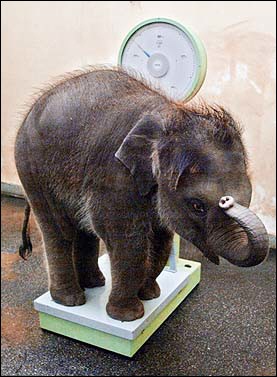
Baby elephant.
From the Most Emailed list at Yahoo!, this.
January 07, 2004
Rubber-necking.
This morning hitched a ride in to the office park, but our speedy progress was thwarted first at Grand Ave, by a crashed big rig and then near Millbrae, where a single car was resting quietly in a bed of succulent ground cover. We came to an almost-complete stop to gaze upon the wreckage, prompting an angry honk from the driver behind us.
January 06, 2004
Invitation to a public forum.
Caltrain are inviting public comment on revised time-tables for the upcoming Bullet Train service.
January 05, 2004
Donut deception.
Subject: eats doughnuts and leaves
http://www.nytimes.com/2004/01/05/books/05GRAM.html
Despite Best Efforts,
Doughnut Makers
Must Fry, Fry Again
Low-Fat Version of the Treat
Proves Hard to Roll Out;
Mr. Ligon Lands in Hole
BySHIRLEY LEUNG
Staff Reporter of THE WALL STREET JOURNAL
Robert Ligon, a 68-year-old health-food executive, is scheduled to
begin serving 15 months in a federal prison Tuesday. His crime:
willfully mislabeling doughnuts as low-fat.
Exhibit A: The label on his company's "carob coated" doughnut said it
had three grams of fat and 135 calories. But an analysis by the Food
and Drug Administration showed that the doughnut, glazed with
chocolate, contained a sinfully indulgent 18 grams of fat and 530
calories.
=A0
Mr. Ligon's three-year-long nationwide doughnut caper -- which involved
selling mislabeled doughnuts, cinnamon rolls and cookies to diet
centers -- began to crumble when customers complained to the FDA about
how tasty his products were.
"If it sounds too good to be true, it probably is," says Jim Dahl,
assistant director of the Office of Criminal Investigation for the FDA.
The skinny on low-fat doughnuts, he says: "Science can do a lot of
things, but we're not quite there yet."
The low-fat doughnut is the Holy Grail of the food industry. Food
companies have been able to take most of the fat out of everything from
cheese to Twinkies. But no one has succeeded in designing a marketable
doughnut that dips below the federal low-fat threshold of three grams
per serving. Doughnuts typically range from eight grams of fat for a
glazed French cruller to more than double that for a cake-like
doughnut.
Perhaps no other bakery good is so dependent on fat. After the batter
is shaped into rings and dropped into hot oil, the deep-frying process
preserves the shape, gives the doughnut a crust and pushes out
moisture, allowing for the absorption of fat. The fat itself is
responsible for most of its flavor. A doughnut contains as much as 25%
fat; the bulk of that is the oil absorbed during frying, according to
the American Institute of Baking, a research and teaching outfit funded
by the baking industry.
The low-fat doughnut, declares Len Heflich, an industry executive at
the American Bakers Association, is "not possible."
That hasn't stopped almost everyone in the approximately $3 billion
doughnut industry from trying. In the late 1980s, Dunkin' Donuts
briefly offered a cholesterol-free doughnut that contained no eggs and
no milk. It went nowhere. During the 1990s, Entenmann's Bakery offered
a doughnut with 25% less fat but poor sales forced the company to
shelve it. Krispy Kreme Doughnuts Inc. has explored low-fat or
low-calorie options but has yet to roll one out. Some bakeries sell
"baked doughnuts" that are low in fat, but doughnut-makers say that's
cheating: If it's baked, it's a cake.
Scientists are also trying to put the doughnut on a diet. U.S. Patent
No. 6,001,399 claims that replacing sugar with polydextrose -- a
low-calorie synthetic sweetener commonly found in ice cream and frozen
foods -- can reduce the doughnut's absorption of frying fats by 25% to
30%. U.S. Patent No. 4,937,086 says that injecting polyvinylpyrrolidone
-- which normally keeps pills in packed form -- into the doughnut=20
batter reduces fat by 30% without a "pasty or greasy taste."
In an article entitled "Development of Low Oil-Uptake Donuts" published
in 2001 in the Journal of Food Science, scientists at the USDA
Agricultural Research Service wrote that adding rice flour to the
traditional wheat-flour-base doughnut mix lowered fat by 64%. Fred
Shih, a chemist who helped author the study, says the doughnut that
resulted was tasty, but he doesn't expect to see it on grocer shelves
anytime soon.
"It worked in a lab," he says, but "it may not be so easily converted
into commercial operation." (One kink: short shelf life.)
Despite its no-cholesterol-doughnut flop, Dunkin' Donuts, the nation's
largest doughnut chain, continues to push ahead in the quest for a
low-fat doughnut. The company's doughnut technologists have all but
ruled out tinkering with its closely held, 26-ingredient batter, which
contains little fat. The chain, a unit of London-based Allied Domecq
PLC, has tried frying dough in a fat substitute but feared its
digestive side effects would leave a bad taste.
At its product laboratory in Braintree, Mass., on a recent morning,
researchers in white lab coats tasted and prodded their latest
prototype: a chewier-than-average doughnut that is not fried, but made
on a machine that resembles a waffle maker. The result weighs in at 150
calories -- half the amount of its full-fat cousin -- and fewer than
three grams of fat. Still, this doughnut fails to meet Dunkin's
standards of texture, taste and something called "mouth feel."
"We would love to be able to offer a great-tasting doughnut that is
low-fat," says Joe Scafido, chief menu and concept officer for Allied
Domecq's quick-service restaurants, "but I'm not sure we're going to
get there."
The criminal files on doughnut-related fraud thickened in the 1990s
after new federal laws required more-detailed labeling of food. The
FDA's Office of Criminal Investigation says that about a quarter of its
cases involve food, most related to tampering. About 20% of those food
cases are related to "misbranding" of food, such as false labels or
misstated country of origin.
Mr. Ligon, who is scheduled to begin his sentence Tuesday, was not the
first doughnut derelict. In 2000, Vernon Patterson, president of
Genesis II Foods Inc., an Illinois bakery, pleaded guilty to one count
of mail fraud for passing off three varieties of doughnuts as low-fat.
According to federal court records, customers helped build the case
against Mr. Patterson by raising questions about his suspiciously tasty
low-fat treats. Mr. Patterson served one year and one day in a federal
prison.
The doughnut ring of Mr. Ligon, a former weight-loss-center franchisee,
began in 1995, the FDA says. That's when he started a weight-loss
product company, Nutrisource Inc., to sell protein shakes, nutritional
bars and baked goods to diet centers. According to Rudy Hejny, the FDA
agent in charge of the investigation, Mr. Ligon bought full-fat
doughnuts from Cloverhill Bakery, a Chicago company, and repackaged
them as diet doughnuts. It was a lucrative operation: Mr. Ligon would
buy doughnuts for 25 cents to 33 cents each and then resell the
mislabeled versions for a dollar each.
Customer complaints to the FDA started rolling in, questioning whether
these were in fact low-fat doughnuts. So did one from a packaging
company Mr. Ligon hired to label and distribute the doughnuts. Key
evidence: One of its employees gained weight after eating Mr. Ligon's
doughnuts.
The FDA launched an investigation in 1997, tracking down Mr. Ligon's
customers and former business partners in a previous
weight-loss-product company. Investigators learned that this wasn't Mr.
Ligon's first brush with improperly labeled doughnuts. One of his
former customers, the owner of a weight-loss center, had grown
suspicious after briefly placing one of his doughnuts on a napkin to
answer the phone.
"She saw a grease ring," says Mr. Hejny. The customer had the doughnut
independently tested and discovered it was not low-fat. No legal action
was taken.
In the summer of 1997, the FDA, armed with search warrants, raided Mr.
Ligon's office and packaging facilities in Kentucky and Illinois,
seizing 18,720 doughnuts, along with cinnamon rolls and labels. Mr.
Ligon shut down the business, but the FDA pursued a criminal case.
In 2001, a U.S. District Court grand jury in Chicago indicted Mr. Ligon
on mail fraud for his role in carrying out a scheme that involved
shipping falsely labeled goods. In September, Mr. Ligon pleaded guilty
to one count of mail fraud. At the time of sentencing, the government
calculated he attempted to sell several hundred thousand dollars' worth
of mislabeled doughnuts and cinnamon rolls.
"Mr. Ligon abused the trust people put on these labels," says Stuart
Fullerton, the assistant U.S. attorney who prosecuted the case. "It's
kind of cruel on his part to do this."
Reached on his mobile phone, Mr. Ligon says he didn't intentionally
break the law and never heard a single complaint about his doughnuts.
"Everybody wanted the product and were very upset they couldn't get the
product," he says. Asked if he felt the punishment fit the crime, he
says: "I feel like I've been singled out."
For all his troubles, Mr. Ligon says he doesn't even eat doughnuts.
That works out fine. Most federal prisons, says a spokeswoman, don't
serve doughnuts.
Write toShirley Leung atshirley.leung@wsj.com
January 04, 2004
The year of the monkey.
Toddler triumphs in National Monkey Face Championship
A 2-year-old boy has won the National Monkey Face Championship held at the Yomiuriland amusement park in suburban Tokyo to commemorate 2004 as the Year of the Monkey.
The boy, whose parents did not want to be identified, won for the face he pulled as he screeched, "I love bananas. I eat five bananas a day."
He was awarded with one month's supply of bananas for his victory and appeared delighted to have won the prize.
Competitors ranged from infants to high school students.