April 24, 2004
'swell
After several months of languishing in the workshop, the Kogswell F58 finally came into its own. I picked up a few last-minute parts (and a *cough* new saddle) at American.
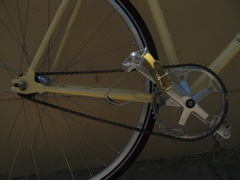
I swear, threading the leather straps through the clips and pedals took longer than assembling any other part of the bike. And after I finally got one pedal done (I sat out in the park, acknowledging that it would take a long time), I discovered that I had the buckle on the wrong side; I patiently re-threaded.
April 23, 2004
Why they were concerned for my welfare, I don't know, but they were from Belgo Nord
Listening to the sentimental style of San Francisco's A Minor Forest: So, Were They In Some Sort Of Fight?
The location, usually oral, of introducing a new clause after a full stop (.) with "Particles lend indispensible amazing power to sentences, but there's something about so that grates on me; all the more so (!!) in writing.
April 22, 2004
Bargee brings mud!
The New York Times' Monica Davey has a spectacular piece on mud transplantation, from Peoria to Chicago.
In Chicago, United States Steel will use the nutrient-rich mud to slather a slag heap on the South Side, making a 573-acre site habitable.
Meanwhile back at the Salton Sea, another fabulously muddy area: California lawmakers, having settled with Federal agencies on plans to share water running into the Sea, now have a $730 million development plan.
April 22, 2004
CHICAGO JOURNAL
A Mudflow Rolls to a City That Couldn't Be Happier
By MONICA DAVEY
CHICAGO, April 21 — Chicago needed mud, and East Peoria, Ill., needed to get rid of it.
If the elegant (albeit muddy) solution seems obvious now, remember: these cities are 165 miles apart, and, like most cities, neither had ever devoted much time to pondering the other's problem.
On the South Side of Chicago, 20,000 people had once labored in what used to be the United States Steel Corporation's South Works plant, a symbol beside Lake Michigan of this city's place in building a nation's bridges and skyscrapers. South Works, now empty and closed, filled 573 acres, making it larger than even the Loop, the city's downtown business district. Much of the land was glazed in slag, a byproduct of steel and another reminder of the past.
So when United States Steel and city officials began dreaming several years ago of ways to turn the famed old mill into a new development — perhaps with businesses, homes, roads and parks — the slag posed a problem. How exactly would one set a grassy park on slag, where grass will not grow?
In East Peoria, meanwhile, an entirely different question was being asked.
More and more sediment was accumulating on the beds of Upper and Lower Peoria Lakes, thanks in part to the development of a navigational channel in the Illinois River, which runs through the lakes.
Once six to eight feet deep, the lakes had shrunk to depths more appropriate for a bathtub. Sauger, bass and sunfish were left searching for room to swim. The duck population sank by 90 percent. And people with boats began to fear sucking mud, not water, into their motors.
But where exactly would one throw away all this muddy sediment, especially given the high prices of disposal?
That was where John C. Marlin, a scientist so curious about mud that he has taken hundreds of photographs of it (wet, dry, cracked, caked), stepped forward. Dr. Marlin, a senior scientist in the waste management and research center of the Illinois Department of Natural Resources, has been fascinated with silt and sediment for more than three decades.
Standing on the South Works site in the shadow of the old ore storage walls on a recent morning, Dr. Marlin smiled as a crane lifted giant fudgy scoops of mud from a barge that had come from East Peoria.
"There was no real epiphany moment," he said of his realizing that East Peoria's problem could fix Chicago's, and vice versa. "I just started looking at maps and thinking about it."
For at least the next six weeks, barges loaded with mud from the bottom of Lower Peoria Lake will make the 165-mile, two-day journey to the edge of Lake Michigan. There, hundreds of truckloads of mud will be dumped on the slag-covered land. And by summer, Dr. Marlin said, grass will grow on the acres meant to become a city park.
Seventy barges will make the trip, each with 1,500 tons of mud. In the end, more than 100,000 tons of mud will frost the top of this land.
The mud is safe, the federal Environmental Protection Agency reported after reviewing core samples from the lakes. And most of a $2 million grant from the state is paying to transport it — a deal, in the eyes of Chicago officials who needed clean dirt and East Peoria officials who did not.
"We needed good quality soil," said Mayor Richard M. Daley, "and basically this solves two environmental problems, one urban and one rural."
On the rural end, in East Peoria, officials watched with relief in recent days as a public marina in Lower Peoria Lake got deeper.
"We've waffled in the past as to whether our marina could even stay viable or not because of the expense of dredging," said Brad Smith, executive director of the Fon du Lac park district. "This gives us somewhere to take the stuff."
If everything works out here, Dr. Marlin said, he has dreams of similar projects in other places, of other happy marriages between localities separated by so much distance.
"Why not?" he said. The Peoria Lakes alone, he estimated, have gathered enough extra mud to fill a football field that reaches 10 miles high. "Just imagine," he said.
Copyright 2004 The New York Times Company
April 21, 2004
Because they were real squirrels!
Second coffee of the day, and I'm listening to Shellac of North America. Who described this band as surgically-precise rock & roll?
I mean, goddammit, I miss the Lounge Ax.
Although I don't have a definitive database (and iCal spiffiness) like Greg, I recall having seen Shellac in many memorable places (and at memorable times: the Sunday morning church service). And having eaten fish an' chips with sundry members. I like their frank Q & A sessions, their spare on-stage presence, and the fact that they sing a song against itself.
Oh you pretty things
The Randall Museum, a "spot in the heart of the city where young people could spend a day in the country," was once housed in an old city jail; now its own building nestled in Corona Heights, it has a spectacular live-animal exhibit as well as a model railroading layout and expansive outdoor area. As its funds from the city dry up, the Randall Museum faces an uncertain future. Operating funds from the City and County of San Francisco may not be enough to sustain the Museum; the city faces a massive ($352 million)shortfall in revenue. The Friends of the Randall have proposed a privatization of the musuem.
April 20, 2004
Adventures on Caltrain, Pt. 3
This morning I rode the bike to the CalTrain. In the seat across from me, a heavily-tattoo'd man hummed along with a Palaestrina score, miming the actions of a chorale conductor.
The mutton-chopp'ed conductor hollered "High Ball! High Ball!" as the train pulled away from the terminal, precisely on-time.
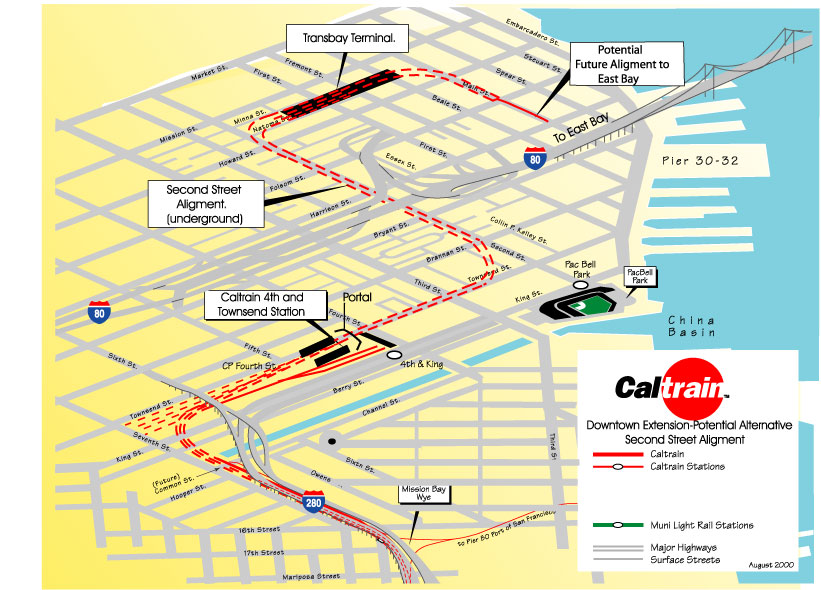
And I read about the (re-) construction of the Transbay Terminal ("An idea that has been in the works for 37 years"), a $2 billion project San Francisco voters approved in 2000.


April 19, 2004
Going 'round in circles no more
The traffic circles will go away.
Alleluia.
Addendum: Bay City News, The San Francisco Examiner, and the San Francisco Chronicle all ran something along these lines:
A traffic-control experiment that had Haight-Ashbury residents driving in circles has been halted.
The Department of Parking and Traffic ended its test of traffic circles on Page and Waller streets this week after the idea collided with opposition from neighbors, the Fire Department, and pedestrian safety and disability rights organizations.
The department took out stop signs in August and installed temporary traffic circles at five intersections on Page and one on Waller Street. The idea was to encourage bicycling, improve air quality and slow speeders.
Earlier this year, the department sent ballots to residents within a block of the intersections asking them whether to keep the traffic circles or bring back the four-way stops. None of the circles received the majority vote needed.
"It wasn't close,'' said department spokeswoman Bridget Smith.
©2004 San Francisco Chronicle
April 18, 2004
Pride before a fall
I got a new un-stained-with-coffee hoodie today. Meanwhile, Aram and Mary got new 'phones.

All you punks and all you teds
Rolled up to the house after a test run on a freshly-tuned Dutchess, and a grungy bearded man was sitting on the stoop, drinking from a 40 and eyeing a bicycle leaned up against the house.
No, it wasn't Aram; it was a ruddy-faced man, grey and dirty, who was doing pretty much as Aram or I might: sitting on the stoop, knocking back a beer, and working on a bike.
In fact, when I first sped past the house I thought he had stopped because of bike problems -- perhaps he saw the sprocket charm on the threshold? -- and I pulled over to ask: "Is everything OK?" but he said, "I'm painting my bike." Even as I asked I knew that he was a bum, and the belligerent tone in his answer bespoke that.
I suggested that he move on -- I needed to get past him just to get into the house -- and he began a mock-polite argument. He ended up taking his gold paint pen to the house next door, yelling at me that I couldn't push him away from the neighbour's as well, could I?