July 17, 2004
It doesn't shit in the woods.
Went for a walk through the Marin Headlands with Anna, wildlife educator extraordinaire, who pointed out some black bear scat on the Coastal Trail. Several dried patties appeared in a hundred-yard stretch, leading to a theory of a bear with diarrhea. When we got back to the trailhead at Muir Beach, we saw that rangers have in fact posted warnings of a black-bear sighting, the first in 75 years.
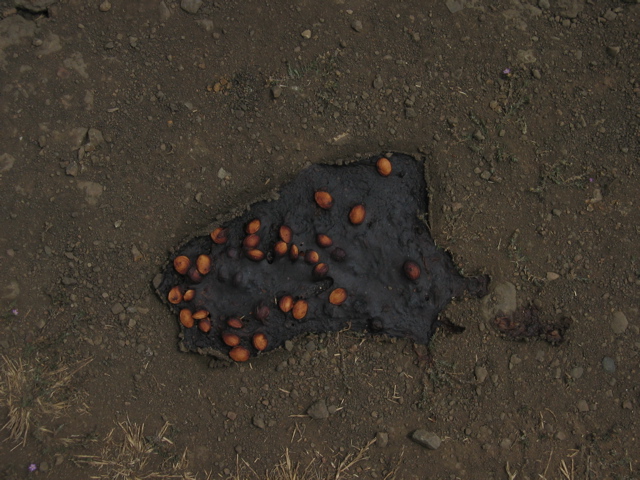
And this is as good a time as any to mention my favourite online bear. It doesn't shit in the woods, either.
July 16, 2004
Complete & Uncut
After a harrowing trip home on the J-Church, I debarked at the corner of Church and Duboce and walked in to the Out of the Closet shop to look for a copy of a book: Stephen King's Complete & Uncut "The Stand". I read the cut-for-weight version about 20 years ago, but thinking about germ warfare lately has caused this novel to reënter my mind.
To my surprise and delight, I found a crisp hardcover, dust jacket in Brodart even, with the promotional bookmark tucked neatly inside it. Perfect! Just as I picked it off the shelf, the lights dimmed and a clerk announced that the store was closing; "Please bring purchases to the counter."
I sailed away to China
File a complaint with the CPUC
I received a leter from Kathleen Nelson stating that the utility company had not been able to read my electric meter for the past 18 months, ''as access to the meter is locked.'' I place plastic cards, which PG&E provides, in an unblocked and unambiguous location in the window immediately next to the front door, facing the street. I have called PG&E on more than one occasion to ensure that they have noted this practice and location in their records. I have spoken with a ''Kathleen'' at PG&E within the past 18 months, and with other representatives, because I have repeatedly received notices from PG&E meter readers to the effect that they are unable to find or read the PG&E-provided plastic cards. The telephone number (415 695 3598) that PG&E provides, both on the notice the meter reads and in the letter that Ms Nelson sent, does not answer during the hours listed ( 7:30 a.m. - 3:30 p.m.), nor is voicemail provided, either during or after hours. Letters to Ms Nelson at the return address on the envelope (2180 Harrison St. SF CA 94110) go without reply. Over the past 18 months, I have paid the monthly bills for both the gas and electric meters attached to my account. If the utility were unable to read the meter, how did they send these bills? This is not acceptable practice for a corporate utility. I strongly protest the repeated inaccuracy of their meter readers, the claim by the utility that they cannot read my meters over the past 18 months, as I have been paying regularly. I object to their lack of customer focus.
July 15, 2004
Tomorrow's man and me
Yerba Buena Center for the Arts opens a new exhibit, featuring Twist.
His one-man show at Brandeis was written up in the New York Times earlier this week. He's been written up in lots of fun places.
Although I haven't yet been to The Independent, the successor to the Justice League, word is that the beautiful Twist murals have vanished. Alas!
July 14, 2004
Another side of ...
Today got off to a slow start: the coffee shop was inexplicably shuttered, and I couldn't focus on work.
But then I found a trove of Royal Truxxx CDs on my way out the door, and spent myself listening to their distrait song "Junkie Nurse".
As Aram (in whose 55th St. apartment I first heard this song) put it, "Putting the win back in heroin."
... speaking of which, now I'm listening to Jonathan Fire-Eater's stellar "Tremble Under Boom Lights" EP.Why don't I listen to something uplifting, like James Brown?
July 13, 2004
Reduce, reuse, and ...
Today is a five-newspaper day: The Wall Street Journal (courtesy Aram), The New York Times, the San Francisco Independent, the venerated San Francisco Examiner, and the suitable-for-puppy-training San Francisco Chronicle. If I jump on CalTrain, I can also pick up a copy of the San Mateo Daily News. And what of all this newsprint? Almost two pounds that I'll haul back and forth, and then dump into a recycling bin.
Why do I prefer the newsprint editions of these 'papers, all of which are available (in some form) on-line? And why do I contribute to the consumption of our limited paper resources?
July 12, 2004
2005 Sunrise
From C|Net or the New York Times, come reports that American hegemony of the bar code is slipping away with the adoption of new international standards.
Global trade depends on uniform identification of products, and the UPC symbol -- developed half a century ago -- forms the basis of a robust system for tracking inventory and prices. However, the U.S. has stuck to its 12-digit UPC code,
How much instant-recgonition and automated tracking does our world need? Do bar-code concepts extend to fingerprinting human faces?
Bar code technology is about to get a face-lift, and IBM aims to be the surgeon of choice. IBM on Monday announced services to help retailers and makers of packaged goods prepare for new bar code standards set to take effect at the start of next year. The Uniform Code Council, the group behind the Universal Product Code information found on everything from window cleaner to Windows software packages, has declared that by Jan. 1, all U.S. and Canadian companies must be able to scan and process product symbols used elsewhere in the world--at the point of sale. The council announced its "2005 Sunrise" program in 1997, but many companies are not yet prepared for the change, said Ray Tromba, director of retail application management systems for IBM Global Services. "Changes in the checkout registers, including IBM's point-of-sale systems, have been introduced over the past eight years," Tromba said in a statement. "But time is running out, and most companies have been slow to change their core business applications." IBM isn't the only technology services firm hoping to help companies get their bar code systems up to snuff. Electronic Data Systems and Cognizant Technology Solutions have also announced efforts focused on 2005 Sunrise. For the past 30 years, U.S. products have been labeled with 12-digit UPC symbols. But outside the United States and Canada, retail products are marked with EAN-8 and EAN-13 symbols, using the European Article Numbering system. To sell those products in the United States and Canada, manufacturers have to relabel them with a 12-digit UPC symbol, adding expense and delays, according to the Uniform Code Council.
After Jan. 1, Uniform Code Council "company prefixes" will no longer be issued to new companies based outside of the United States and Canada. "Therefore, these new companies will be marking their products with EAN-8 or EAN-13 symbols," according to the council. This means that U.S. retailers need their computers to be able to recognize the EAN tags. As an advancement of traditional bar code systems, companies are also developing radio frequency identification, or RFID, technology. RFID systems combine chips that carry descriptive information with radio frequency technology to track inventory. Because numbers in the 12-digit bar code conveyed information about product maker and the individual items, retailers built their core business systems--including those managing price and inventory--on the familiar UPC code over the past three decades, IBM said. Big Blue said its Legacy Transformation Services for Retailers use consulting methods and IBM applications to help retailers update and modernize aging computer software, including reworking them for Web-based use. This is not IBM's first experience with the bar code, the company noted. Two IBM employees played key roles in the development of the UPC code, the company said. In 1952, Joe Woodland was awarded a patent as co-inventor of the early concept, and in 1971, George Laurer headed up IBM's development of the concept for the 12-digit UPC, IBM said.
July 12, 2004
Bar Code Détente: U.S. Finally Adds One More Digit
By STEVE LOHR
The humble bar code, the rectangular thicket of slender bars and spaces on products, ignored by shoppers, indecipherable to humans, is joining the forced march of globalization.
For American retailers, whose checkout-line bar-code scanners will be expected to read the global bar-code standard by Jan. 1, the required changes in computer systems and software programs has echoes of the Y2K computer problem.
In the not-so-subtle tug-of-war of trade rules and technology standards, the globalization of the bar code represents a small erosion of American industrial hegemony.
Europe won this one. The global bar code standard will be the European Article Numbering Code. It turns out that the American Universal Product Code - which turned 30 years old last month - was never so universal after all.
The difference between the American and the European bar code standards, as it so often is in computing, is a matter of digits. When the Europeans set up their bar code in 1977, patterned after the American standard, they reasonably decided that they needed extra digital space for more products and identifying countries. (There were 12 nations in the European Community at the time.)
So the European code has 13 digits, while the code used in the United States and Canada has 12. The 13-digit code took off and is used in most other countries. And the American side has finally made an accommodation with reality. The Uniform Code Council, the North American arbiter of bar codes, has told North American retailers that bar-code scanners will have to read the 13-digit codes by January. The 12-digit codes do not die; systems that can read 13-digit codes can also read 12-digit codes.
"But the 13-digit standard is what it's all moving to," said Ray Tromba, an expert in retail and consumer products distribution for IBM Global Services. "The 13-digit is the global standard."
The bar code's globalization is a sign of its triumph over the years. As the identifying code of modern commerce, it has made possible everything from faster checkout service to sophisticated market research. More than five billion bar-coded products worldwide are scanned every day.
When the bar code arrived three decades ago, the computer revolution was beginning in earnest. Low-cost, powerful computing and vast databases, experts say, helped reduce labor costs, change the relations between manufacturers and retailers and hasten the rise of efficient mass-merchandisers like Wal-Mart - and the bar code was central to that revolution.
"The bar code opened a gold mine of data," said Janice H. Hammond, a professor at the Harvard business school. "Without the bar code, it would be a whole different ballgame in retailing than it is today."
The bar code's story is a striking example of how new technologies become adopted, and perhaps holds some lessons.
The successful spread of the bar code may seem inevitable, but only in retrospect. Even after its commercial introduction on June 26, 1974, when a pack of Wrigley's Juicy Fruit gum was scanned at a grocery store in Ohio, there were rocky years.
Consumer groups protested the bar code, saying that shoppers would be cheated if price tags were not on each item. Labor unions decried the possibility of job losses from the labor-saving technology. There were environmental worries that the laser scanners in the bar-code readers might damage people's eyes.
By 1976, the initial wave of enthusiasm had faded when BusinessWeek magazine ran an article headlined, "The Supermarket Scanner That Failed." Predictions that 1,000 or more grocery stores would have installed bar-code scanning systems by 1976 proved wildly optimistic. Only about 50 stores in the United States had them, BusinessWeek reported, and bar-code equipment makers, including RCA, Pitney-Bowes, Singer and Bunker Ramo, had fled the field.
In the early years, it took a pioneering spirit and a leap of faith for a company to put in scanning systems. The first was a Marsh Supermarket in Troy, Ohio.
"We've always been innovative and tried to be on the leading edge of technology, but that first store wasn't easy," recalled Don E. Marsh, the 66-year-old chief executive of Marsh Supermarkets, a regional chain with stores in Ohio and Indiana.
A faster, more efficient checkout process and instantaneous inventory and sales data were significant benefits. But in the early years, manufacturers did not routinely put bar codes on products, so the stores had to print bar codes and put them on the products. That meant about 200,000 products a week had to be labeled at the Troy supermarket, adding to labor costs.
"You don't get an immediate return for some investments," Mr. Marsh explained, "but we did see the potential of the technology."
Claude Fenstermaker, the current manager of the Troy supermarket, was a 21-year-old assistant manager at the time. "When it started, I didn't have a clue where the technology was headed," Mr. Fenstermaker said. "Today, I don't know how we would get by without it."
Though it took retailers with vision to deploy the bar code in the 1970's, the idea for the technology actually goes back to the late 1940's. Two graduate students at Drexel University, Norman Joseph Woodland and Bernard Silver, first thought of using Morse code, printed out vertically. They later switched to the bars-and-spaces format, and they filed for a patent in 1949, which was issued in 1952.
The technology languished until August 1970, when a meeting of chief executives of major retailers and food manufacturers like A&P, Kroger, Winn-Dixie, General Mills, General Foods and H. G. Hines convened at the O'Hare Inn, near the Chicago airport to decide whether to move forward with the technology.
It was a "last gasp" effort to chart a compromise between the retailers and manufacturers, said Stephen A. Brown, former legal counsel to the Grocery Manufacturers of America, who was at the meeting.
"Everyone knew the technology was there, but it took the involvement of the top management of the end users of the technology to really push the standard," said Mr. Brown, author of "Revolution at the Checkout Counter: The Explosion of the Bar Code."
Eventually, in April 1973, a linear bar code, mainly developed by Mr. Woodland, who was then working for I.B.M., was adopted. The Universal Product Code, as it is called, is a string of digits - one group to identify the manufacturer, another group to identify the product, and one "check digit" for automated error-checking.
"The genius of the standard was its simplicity," said Tom Brady, a former NCR engineer who helped install the first scanners in Troy, Ohio. "It is a simple ID that triggers all the electronic data that is now so necessary to modern automated commerce."
The technology's standards bodies are becoming a single global group as well. EAN International, based in Brussels, and the Uniform Code Council, based in Lawrenceville, N.J., will be folded into one organization, called GS1, next year. The global headquarters will be in Brussels.
For American retailers, conforming to the 13-digit standard requires retooling software programs. "We're well along," said John Metzger, chief information officer of A&P. The grocery chain, with 630 stores, has handled the problem as part of a modernization of its technology systems. "It is important," Mr. Metzger said, "but it is not a shut-the-company-down kind of issue."
But are the days of the simple bar code numbered now that new-generation radio frequency identification tags, which can transmit far more data, are arriving on the scene? The expert view is that the two technologies will live together for a long time.
"If I walk into a supermarket 20 years from now and there's a box of cereal without a bar code on it," declared Alan Melling, a senior director of Symbol Technologies, which makes both bar code and radio tag readers, "I'll eat it without opening the box."
Copyright 2004 The New York Times Company
July 11, 2004
These are the people that you meet Pt V
Down at Zeitgeist, Thomas told me about how Irish transportation infrastructure emulates American: sprawling suburban developments, built without thought to non-private transportation.
I like this place: I walk in, the bartender looks up and says, "The usual?" even though I haven't been coming here regularly since last year. A couple of drinks later, I wandered over to the food counter and Derek smiled and said, "Hey Salim, what'll it be today?"

