May 21, 2005
How we read today
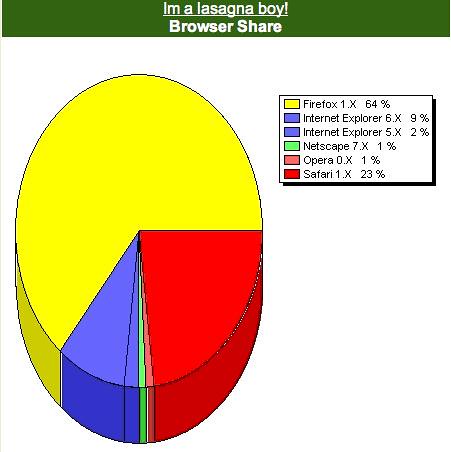
An ugly chart, which shows that you, d. readers, are using hip browsers.
More successful than anyone thinks
The NYTimes, soon to begin charging for online content, has a story about the MTA's $3 million in missing revenue. As it turns out, the Metrocard is more popular than expected, and more riders are buying the deeply-discounted 30-day electronic farecards.
The 30-day MetroCard became more popular with subway and bus riders in March, right after its price increased, surprising transit officials who had thought that demand would slacken, at least temporarily.
Statistics released by New York City Transit yesterday offered the first glimpse at changes in fare-purchasing patterns since fares went up on Feb. 27.
Unlike previous increases, the February increase affected only the 7-day and 30-day unlimited-ride fare cards, along with express-bus fares. The base fare, $2 for a single subway or local bus trip, did not change, nor did the discount for regular MetroCard purchases of $10 or more.
The price of the 7-day card rose to $24 from $21, or 14.3 percent. The 30-day card rose to $76 from $70, or 8.6 percent.
In March, the 30-day card accounted for 28.1 percent of all fares sold, the highest proportion recorded since unlimited-ride cards were introduced in July 1998. A year earlier, the monthly card accounted for 23.6 percent of sales.
In contrast, the 7-day card accounted for just 22.6 percent of sales in March, the lowest proportion since June 1999 and a significant drop from 27.5 percent a year earlier.
Fares have become far more complicated in the past decade. The MetroCard was introduced in January 1994, free transfers between subways and buses in July 1997, volume discounts in January 1998 and a one-day, unlimited-ride Fun Pass in January 1999.
Riders face a hodgepodge of calculations in determining which type of fare card makes the most sense. They must take into account not only their regular commute, but their likelihood of using a subway or bus on holidays and weekends.
The transit agency, which is the largest subsidiary of the Metropolitan Transportation Authority, uses economic models to predict the effects of fare increases.
The agency predicted that the February increase would result in a shift away from both the 7-day and 30-day cards and toward the regular cards. (With the discount, a $10 card is good for six rides, at a cost of $1.67 a ride.)
Instead, customers appear to have moved away from the 7-day card while the 30-day card has kept its customers and may have attracted some new ones. It is possible that many riders take the subway so often that the $6 increase was not enough to deter them from buying the card.
Fare revenue in March was $2.9 million less than predicted: about $236 million compared with about $239 million. In addition to the effects of the fare increase, bad weather might have decreased ridership.
"What you're really doing is a little crystal-balling as to what people's buying patterns will be," said Lawrence G. Reuter, the president of New York City Transit. "You can't be 100 percent accurate in these models."
In an effort to help protect transit revenues, a committee of the authority's board approved changes yesterday to bring the rules of conduct for customers in line with a new state law. The law makes it a misdemeanor, rather than a violation, to sell a ride to another person by swiping an unlimited-ride card or by tampering with an expired card.
May 20, 2005
Total fucking godhead
Or, I'd like to check out your public protest. Another list? -- stop reading, stop reading for me now.
I need a formula to tell iTunes to list albums whose consituent songs all have four or more stars, or where the overall star rating averages to greater than four. This needs some sort of declarative language -- aha! Apple Script!
I suspect that the list generated will include:
- The Beach Boys' "Pet Sounds" (mono version ; stereo version ; studio out-takes)
- Captain Beefheart and The Magic Band's "Shiny Beast (Bat Chain Puller)" and possibly also "Ice Cream for Crow"
- Emmylou Harris' "Wrecking Ball"
- The Fall "Live At The Witch Trials", "Totale's Turns (It's Now or Never)", "458489 A Sides", "This Nat-ion's Saving Grace"
- Pavement's "Crooked Rain, Crooked Rain"
- Pere Ubu's "Dub Housing"
- Radiohead "OK Computer"
- The Replacements' "Let it Be"
- Talking Heads' "Fear of Music"
- Tindersticks "Tindersticks" (the one that NME called "Total f**king godhead")
- Wilco's "Summer Teeth" and "Yankee Hotel Foxtrot"
- Yo La Tengo's "An then nothing turned itself inside-out"
May 19, 2005
Is that a bicycle when it rains?
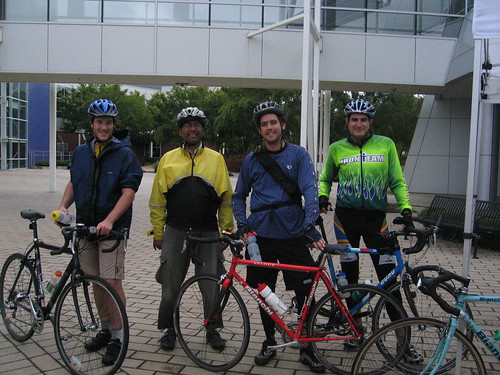
Today I got a good morning's wear on my Burley rain jacket, and began wondering if there really is something to riding a bicycle with gears (lots o' them). All in all, a great Bike to Work Day (rain or shine!).
May 18, 2005
"We really tried"
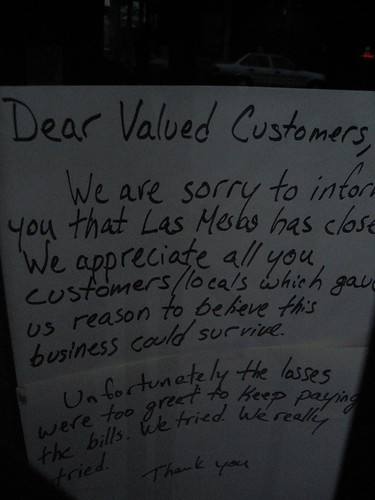
In a textbook illustration of schadenfreude, I chuckled when I saw today that Las Mesas has breathed its last. After (temporarily) losing their beer-and-wine licence, they never recovered, despite opening occasionally for "Mexican breakfast". After initially welcoming me and others last July, the shop's owner disappeared, replaced by a changing stream of hapless, arithmetic-impaired waiters. If they didn't forget to put chicken into your chicken enchilada, they gave out wrong change -- or both. The last time I visited, they confusingly deducted tax from the refund they gave after they realised they didn't have the ingredients to make the dish I had requested. Although I am sad to see the chic décor and the lush outdoor garden go, Las Mesas never made good use of either. Good riddance to this mediocre restaurant.
Some local businesses have saddened me greatly when they closed, especially when it happened prematurely. Opening a small business of any kind, not just a restaurant, takes great courage: running it effectively and building a loyal clientele takes an impressive amount of dedication and energy. Las Mesas, however, squandered its great location, cheap an' easy food, and nice décor by providing indifferent food, shabby service, and erratic opening hours.
May 17, 2005
Excepting every four hundred years.
Prompted by a technical discussion about date formats, I dug out a copy of David Ewing Duncan's superlative "Calendar: Humanity's Epic Struggle to Determine a True and Accurate Year", and found the author's blog.
As for the automated manipulation of the calendar, a colleague pointed out this tit-bit o' unix fun:
(salim@xampanyet) ~ % cal -3 9 1752

     August 1752         September 1752         October 1752

Su Mo Tu We Th Fr Sa  Su Mo Tu We Th Fr Sa  Su Mo Tu We Th Fr Sa

                   1         1  2 14 15 16   1  2  3  4  5  6  7

 2  3  4  5  6  7  8  17 18 19 20 21 22 23   8  9 10 11 12 13 14

 9 10 11 12 13 14 15  24 25 26 27 28 29 30  15 16 17 18 19 20 21

16 17 18 19 20 21 22                        22 23 24 25 26 27 28

23 24 25 26 27 28 29                        29 30 31

30 31
Just as we find the railroads behind the standardization of clock time, we might credit the Church for the standardization of the calendar, done so that everyone can hunt Easter eggs at the same time.
May 16, 2005
It's good to be back
Swobo are back in effect! ... almost. Now that I am fashion-conscious, it's time to get some warm an' wooly cycling clothes.
Swobo's disappearance (was it five years ago already?) caused lamentation, not only for the loss of their spectacularly beautiful and functional clothing, but for their home-grown attitude and local presence. I also like their logo (apropos of which: while riding a 22 Fillmore past Dolores and 16th yesterday afternoon, one of the women seated next to me hollered out that she saw a lamb! Just like that! Walking with the dogs! And, lo and behold, 'twas a brown-eared little goat or some-such, in the company of two handsome dogs and a human couple).
May 15, 2005
A public telephone
The IMDb biography of Lawrence Tierney really impresses me. Drunken brawling, tough-guy attitude on- and off-screen, and impressions of his throaty, growling voice make for an interesting write-up. Not to mention that he had the best line in Reservoir Dogs, and the last line in Hill Street Blues.
A walk through Looney Valley
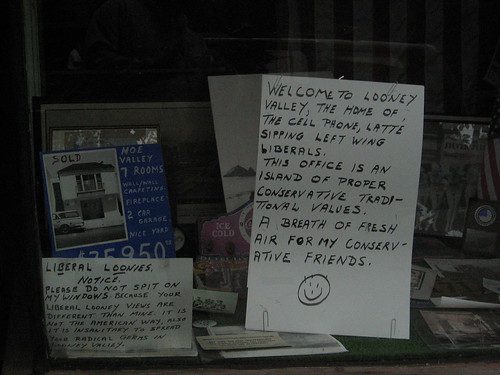
 There's something about the neologism 'insanitary' that especially appeals to me.
And, speaking of politics in San Francisco: earlier in the day I had the good fortune to see Frank Chu in the flesh, part of the Bay to Breakers festivity.