February 14, 2004
Raised to a new height.
I have long said that the only commerical enterprises lacking in this neighbourhood (The Lower Haight) are a donut shop and a bookstore.
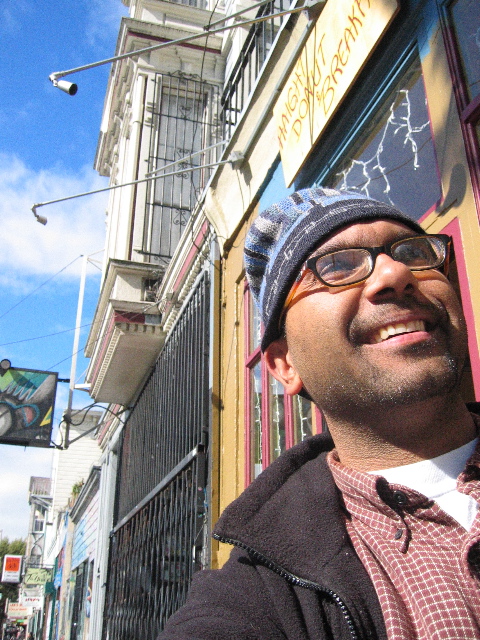
The two Eritrean women behind the counter told me that the Haight Donut Breakfast opened yesterday. Although the donuts are baked offsite (the Mission somewhere?), the several (ahem) I ate tasted fresh and warm. And delicious: none of the tired All-Star or Inga Donut action here.
The Haight Donut Breakfast occupies the storefront on Haight next to The Top, once home to Botana, and is open from 7 ack emma to 10 pip emma.
February 13, 2004
Learning math at the corner store.
Yesterday I smelled something pleasantly tangy as I walked into a meeting. One of my colleagues was nestling a Wint-O-Green Life Saver candy in his mouth.
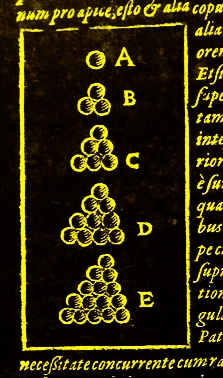
According to this morning's New York Times, scientists have made another important breakthrough in the fascinating field of complex materials theory: the problem of how to most densely pack spherical or round molecules.
February 12, 2004
As Havana, so Damascus.
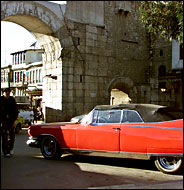
A 1959 Cadillac Eldorado in the Old City in Damascus.

A 1959 Chevrolet Bel Air in Santiago.
The streets of Havana are famously adorned with gleaming old American cars; so, surprisingly, are the souks and alleys of Damascus.
February 12, 2004
DAMASCUS JOURNAL
The 2004 U.S. Is Unloved, but Not Its Cars of Yesteryear
By IAN FISHER
DAMASCUS, Syria, Feb. 10 — Do you like America?
"No," said Majed Aboud, 47, leaving not an inch for doubt. "Because of Bush, they are destroying the world."
So what about all these great cars?
A groan of pleasure escaped the mouth of Mr. Aboud, a mechanic who has spent the last 25 years repairing cars built in the nation he curses.
"Oooohhh," he said. "They are gorgeous."
Like Cuba or Iraq under Saddam Hussein, Syria is condemned to love the cars of its enemy. And Syria's fate — a happy one, mostly, to hear it from owners and the people who keep them rumbling along — is to see perfectly running vintage American cars everywhere, transported metal and memory of a more carefree superpower: big DeSotos like Art Deco locomotives; a two-toned Chevy Bel Air, its eagle hood ornament sleekly guarding a carpet shop; the Dodge Dart, a car that did not seem like much at the time, but which manages better than its boxier brothers through the narrow streets of the Old City in Damascus, the epicenter of an older, now-vanished empire.
There have been no symbolic burnings of, say, a '57 Chevy, here in this nation outraged that America considers it a state sponsor of terrorism, and which — some here fear — may be next on Washington's list for pre-emptive regime change. For one, old American cars are too valuable. Syria imposes a triple duty on new cars, so a new Cadillac here costs $150,000 and a new Chevrolet Caprice ranges from $85,000 to $90,000.
Which explains why Dr. Riab Atwan, 46, a gynecologist, happily paid $12,000 two years ago for a beat-up 1977 Pontiac. His car before was a '63 Chevy Impala, before that a '64 AMC Rambler. The color of this latest car, he said, is "champagne," but you have to ignore the blotchy body work.
"In America it would cost $150 or $200," said Manwail Belian, 59, who owns an authorized General Motors service shop, complete with the latest diagnostic computers and racy pin-ups, featuring one woman in a red-white-and-blue bikini.
Dr. Atwan, who had brought his car in for repair, looked startled for a second.
"Maybe that's normal over there," he said with a shrug.
But, he said, he had no regrets: American cars, for whatever price, are all he will buy. "It's strong and safe and large and long," he said of his Pontiac.
Garabad Demerjian, one of two brothers who own a garage near Mr. Belian's in the industrial zone of Damascus, has a theory about why there are so many vintage American cars still on the road here — and it has little to do with what Syrians think about America. It is a subject near to his heart, apart from the fact that he fixes American cars for a living.
In 1935, his father, also a mechanic, bought one of the few cars in Syria at the time, a new black Chevrolet that the other day was parked a few feet away from him and his brother, Josep, 44, as they drank tea and read the newspaper.
The car was already 17 years old when Mr. Demerjian was born, and it still ran flawlessly. It still does. To prove it, Josep opened the bulky door and turned the key. It started right away, the sound of the engine big and mellow — beautiful, really. The number of American cars still on the road, Mr. Demerjian concluded, is kind of like evolution: the strong made it through.
"You might still find some of the European ones — German and French — but most of what survived is American," Mr. Demerjian said. (To be fair, Syrian streets have a fair share of vintage Mercedeses, Opels, Peugeots and Audis.) The Americans, he said, "were professionals."
"They were geniuses. These cars were perfect."
Perfection is not a term normally applied to American cars of the late 70's and early 80's. So it is no surprise that a micro-industry has grown up around keeping old American cars on the road. In 1969, the father of Nabil al-Far opened a small shop in downtown Damascus importing parts solely for American cars, and the other day it was still uncomfortably crowded with customers. Mr. al-Far was so busy he could talk to a reporter only between phone calls and orders for parts from the stockroom. Business is great, he said.
"Touch wood," he said, knocking on the counter.
Mr. al-Far can get parts for American cars as old as 1935, though most of his business is for cars built in the 1950's, which makes the cars a decade older than he is. Some parts, like suspensions and axles, are even manufactured in Syria. American cars, he said, are easy to repair and the parts are far cheaper than Japanese ones. And despite the strain in ties between Syria and America, he has no problems getting his products from American suppliers.
He did not want to talk politics, but he conceded that America was not popular in Syria these days. But he saw no chance that Syrians — least of all him, who owns a '76 Pontiac and a nice, gray '81 Buick — would stop driving American cars if relations between the two countries got worse.
At a juice factory in the industrial zone, a sick, slightly deaf old man named Manoug Najarian sat alone the other day next to the open door of his office, in view of the 1951 DeSoto pickup truck, a faded blue in the sun. His father bought it that year to deliver soda, a sideline to the family juice business. It is the only car Mr. Najarian, 78, has ever owned.
"It is just like my son or my daughter," he said. "It has been over 50 years. This is a long time."
But, it was suggested, a car doesn't talk back to you, like a son or a daughter. "No," he said, "it does talk to me — when I turn the key."
His driving days ended after he was hurt in an accident eight years ago. But that did not take the value out of the car.
"I just want to look at it," he said. "That is enough for me. And then I can remember when I was young."
Copyright 2004 The New York Times Company
I prefer men to cauliflowers.
Began reading the much-acclaimed novel The Hours. I was lost by the second word ("hurries") in the Prologue; I've a prejudice against fiction written in the present tense. It's difficult to accomplish, because the immediacy it conveys is muted or contradicted by the fact that the action is obviously in the past (the Prologue describes a death; the second chapter helpfully declares "It is Los Angeles. It is 1949." within a few sentences).
I hoped that Michael Cunningham would abandon the conceit after the Prologue, for which I could have forgiven him. I have read, quite recently, a novel which pulled off the present-tense quite surprisingly, but now I can't remember which.
February 11, 2004
Book of Illusions, Nr. 2
I perused Oracle Night yesterday, but was disappointed. The book-within-a-book1, and the book within that, was brilliant, but everything tapered off so suddenly that I couldn't but think, as I approached the last few pages, that I had a truncated copy of the book. Perhaps this printing left out a hundred pages? I wondered hopefully as the antagonist became clear. But no.
1 The multi-page footnotes quickly irritated me. The digressions might have been more effectively worked into the narrative; Auster has shown that he's good with quick asides. The amount of detail worked into the footnotes was unnecessary and disrupted the succinct flow of the narration.
The action of this book is set entirely in New York, in the boroughs of Manhattan and Brooklyn. And a brief, fantastic trip into Queens.
February 10, 2004
Jackasses abound.
Local to my hood o' hoods, where I was a hooligan and rode around on a phat ol' BMX bike and shot off bottle rockets, we discover that stupidity abounds on both sides of the cyclist-trucker divide:
MONROEVILLE, Pa. (AP) - A bicyclist shot a truck driver in the arm during a confrontation that began when the man pedaling the bike made an obscene gesture, police said.
Feb 9, 2004
Bicyclist Charged With Shooting Motorist in Fight Over Obscene Gesture
The Associated Press
MONROEVILLE, Pa. (AP) - A bicyclist shot a truck driver in the arm during a confrontation that began when the man pedaling the bike made an obscene gesture, police said.
Robert Urick, 41, was charged with attempted homicide, aggravated assault and weapons offenses.
William Nicoletti, 51, told police that when he drove past Urick in his pickup truck Saturday, Urick made an obscene gesture.
Nicoletti said he turned around and drove toward Urick, who pulled out a pistol and threatened to shoot, police said. Officers said Urick then reached into the truck and shot Nicoletti once in the arm, and rode away on his bike.
Nicoletti rammed Urick off his bike and they fought briefly until Urick fled again, police said.
Police said they arrested Urick, of Monroeville, later that day, and he told them he made the gesture because Nicoletti had told him to get off the road.
Urick remained in jail Monday in lieu of $100,000 bail. A hearing was set for Feb. 17.
Tic-tic-tow.
I'm re-reading Motherless Brooklyn.
The action of this book takes place almost entirely in New York City, in the Boroughs of Manhattan and Brooklyn, in a two-day period. Towards the end of the narrative, the protagonist (and narrator) takes his first trip outside of the city limits.
February 09, 2004
Where iTunes end and you begin.
From this morning's Business Day (which on Mondays for the past decade has carried the unnerving subtitle, "The Information Industries"):
Steve Halberstadt of Raleigh, N.C., made such a purchase last week after discovering that Apple's iTunes store, the Web's leading downloadable music outlet, had added "The Whitey Album," a 1995 release by Ciccone Youth, a jokey side project of the rock band Sonic Youth. The album's second track album, "Silence," consists of 63 seconds of exactly that. (The band has said, with tongue in cheek, that the track is a version of John Cage's famous silent composition "4'33"," only speeded up.)
After checking out the 30-second preview, which "seemed to be very representative of the rest of the song," Mr. Halberstadt said he could not help but make the purchase.
He described it as "the best 99 cents I've ever spent''
Using the readers' suggestions, Mr. Miller compiled a playlist of "nine tracks of professionally encoded silence, a total of 6 minutes and 44 seconds of the yawning void," downloadable from iTunes for just $8.91. He noted that as with all iTunes purchases, antipiracy measures allow the silence to be enjoyed on no more than three computers.
February 08, 2004
The south takes what the north delivers.
A quick trip to Mitchell's for the chocolate-dipped, and then a visit to Twin Peaks on one of the clearest days I can recall.
From the heights we could see down to Moffet Field, across to Mount Diablo, and out past Sutro Tower to the Farallon Islands.