February 07, 2004
Do you have any room in that hand-basket?
While playing the Boggle Deluxe smackdown at Chez Shumavon-Riley, Aram could not be stopped from putting on the Ritz.
February 06, 2004
Shook me all night long.
UPDATE:
While San Franciscans pull for a later last call, New York City's mayor is pulling for an earlier last call. The New York Times writer described the propsal as " turning New York after dark into Riyadh after noon".
From the text of a San Francisco Late Night Coalition press release:
Supervisor Aaron Peskin has introduced a resolution at the Board of Supervisors encouraging State Assemblymember Mark Leno to develop legislation to extend the last call for alcohol in bars, restaurants and nightclubs in California's largest Cities. The
SFLNC has previously introduced a similar resolution at the Entertainment Commission, which voted unanimously to support it.
The SFLNC supports this resolution in part because "National Traffic Safety Association data indicates that later last call hours do not increase and may actually decrease the number of alcohol related traffic fatalities"; but what of the potential increase in police, fire-fighting, and EMS personnel costs due to later business openings? The cost of having restaurants open later may not be offset by additional tax revenue.
After adoption by the City, the State Senate will need to take up the issue.
February 05, 2004
Flat tire for Caltrain.
From the 5.05 from San Antonio:
Just after leaving the Menlo Park Station, the conductor announced over the intercom that we had a flat tire and were slowing to a halt to see if we could fix it. Did I hear aright?
The Atherton police seem to have blockaded the tracks ahead; we're stopped within sight, perhaps a hundred yards in front of, the Atherton platform.
... everyone is asking the conductor about debarking from the train. Of course, because we're before the Atherton station, no-one can get off.
UPDATE:
The area was taped off as a crime scene; a body bag was visible from the train. I took some photos, and we'll see if any of them turn out.
UPDATE:
From the Chronicle's local news roundup:
A suspicious package addressed to President George W. Bush was detonated by a water cannon at an Atherton train station Thursday, authorities said today.
A postal worker noticed the box in the mail drop at the Caltrain station around 5 p.m. and called police, who in turn called the San Mateo County Sheriff's Office bomb squad, according to sheriff's spokeswoman Bronwyn Hogan.
Hogan said once it was discovered that the parcel was addressed to the president, the U.S. Secret Service and the Bureau of Alcohol, Tobacco, Firearms and Explosives were called in to investigate.
Following an examination of the possible device, the bomb squad blew apart the box with a water cannon, Hogan said.
Authorities are still investigating the parcel and whether or not it was an explosive device. No suspects have been identified.
Trains did not stop at the station and were delayed for more than an hour during the operation, according to Caltrain spokeswoman Jayme Maltbie Kunz.
February 04, 2004
The reading habits of the SOMA-bound commuter.
On this morning's N-Judah, I noticed that everyone in the first car was reading.
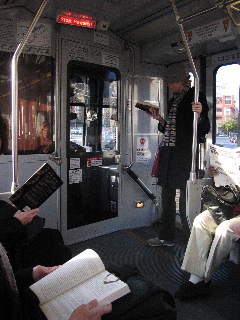
The woman closest to me had an asymmetric heart-shaped bookmark which she had to move each time she turned the page; the woman next to her was agitatedly reading "The Terrible Coil" and nervously looking around; the woman across from her was paging through the San Francisco commuter's treat, The Examiner (whose masthead, I noticed today, has a period after the name: "The Examiner."); standing next to her was a woman cooly reading a paperback.
Everyone, that is, except me: no words in front of my eyes;I was rockin out to The Fall. I picked up an Examiner at the Caltrain station, though, so I could look at the three or four remaining comic strips (down from two full pages just a few months ago) and read the coverage of the Central Freeway development.
February 03, 2004
The true object of my visit is:
Over a workplace espresso yesterday, John recommended Bulgakov's
Reviving an extinct art.
How many ways do you know to scam MetroCard fares?
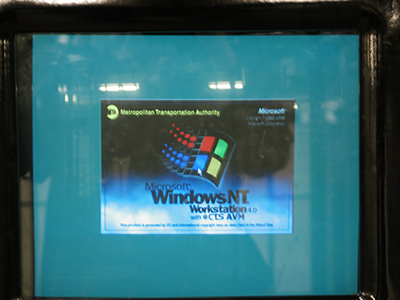
http://www.nytimes.com/2004/02/03/nyregion/03subway.html
February 3, 2004
MetroCard Dispensers Breaking Down, Victims of Tampering and Their Own Success
By MICHAEL LUO
Not quite nine months after the orange, yellow and blue MetroCard became the only way to get through a subway turnstile in New York City, transit workers are called to fix the vending machines that dispense them roughly 800 times a day — with 1,637 machines in the entire system, statistics show.
With each muttered curse from a passenger as a missed train rumbles past, the token's flashy, flexible replacement — the centerpiece of an ambitious vision of a 21st-century transit system — is securing its place in the city's landscape as something to complain about.
"It affects everybody," said Rey Labron, 39, a messenger in Harlem, as he stood in line at a subway booth at East 125th Street because all three MetroCard machines in the station were scrolling the red message "Out of Service" on their L.E.D. displays. "It makes you go to work late when you have to wait on a big line."
To be fair, some repairs involve repeated problems at the same machines, and most of the time the machine is not completely out of order. More often, it is not taking bills, or is refusing to dispense single-ride tickets, or is experiencing some other problem that does not make it absolutely impossible to buy a MetroCard - although that may be little solace to the rider whose bill a machine will not take. And often, the problem cannot be blamed on the machine but rather on the scam artists who have tampered with it. With repeats figured in, officials estimate that about one-third of all the machines are getting some type of service each day.
MetroCard machine repairs have nearly doubled since tokens were eliminated in May, and New York City Transit is looking to increase its crew of MetroCard machine maintainers by 60 percent, to 108, at a cost of $3 million, even as many of its other departments endure cutbacks.
Call it the price of change.
The half-century-old subway token was no match for the MetroCard, its high-tech replacement. MetroCards are critical to transit officials' visions of a 21-century subway system, in which riders buy their fare cards from vending machines, follow electronic voices and signs and ride trains that are controlled almost completely by computer. As part of this effort, the transit agency closed 45 subway booths last August, replacing them with MetroCard vending machines. Seventeen more are to close in coming months.
But by now, most New Yorkers are deeply familiar with occasional MetroCard frustration: entire rows of machines out of order; long lines behind the only working machine or the only one that will take cash; getting to the front of the line to have a machine eat your $5 bill or to discover that it will not take your credit card.
"Just give me my token and let me use it," said Darryl Gates, 39, a journeyman at the Fulton Fish Market, looking to buy a single-ride card from a machine that was being fixed on a recent morning.
The root of the problem, officials said, is not the machines themselves but vandalism and the demands of a 24-hour transit system. Over all, they said, the MetroCard system is a huge success. "There's always going to be issues," said Steven Frazzini, vice president of MetroCard program management and sales, pointing out that the machines processed more than 101 million transactions last year. "They're getting a lot of use."
The nation's second-largest municipal rail system is Chicago's, which carries 1.5 million riders a day, compared to more than 4 million in New York. In Chicago, fare cards are sold only through vending machines, and repair crews respond to about 60 calls a day for 340 machines, a spokeswoman for the Chicago Transit Authority said. In Washington, whose subway system transports 650,000 riders a day, fare card machines work 99.6 percent of the time. But Washington's system and parts of Chicago's shut down overnight. All three cities use machines made by the same manufacturer, Cubic Automated Revenue Systems.
After the vending machines' initial rollout in 1999 in New York, they were failing far more often than transit officials had promised - once every 2,000 transactions, instead of every 10,000 transactions. But after some adjustments, the machines now fail at a rate of about once every 12,000 transactions. The number is deceptive because it does not take into account common headaches like the bill handler getting jammed with an old bill.
"A customer has five one-dollar bills, two fives and a ten," said Paul Korszak, assistant vice president of MetroCard sales and customer service. "It just takes one of those out of a sweaty pocket to introduce a jam."
The problems have created more than a few busy days for the mobile teams responsible for keeping the machines running. Louis Maldonado, 39, and his armed partner, Michael Hickman, 61, were camped the other day in front of two machines at the William and Fulton Streets entrance of the Broadway-Nassau subway station. After fixing a half-dozen machines at another station earlier in the morning, they arrived to find the two machines not taking bills.
The problem turned out to be vandalism: Mr. Maldonado reached into both machines and fished out MetroCards stuck in their bill-handling units.
Of 25,382 repairs in December, 16,936 involved the bill-handling unit. About 45 percent of these - or 30 percent of all repairs - were caused by tampering. The tamperer's goal is to break the machine so that riders will be forced to use the services of a person who just happens to be waiting nearby with a handful of unlimited-ride day passes offering to swipe people through for $2.
"They start a transaction," said Antonio Suarez, chief officer of automated fare collection equipment maintenance for the transit agency. "Instead of money, they introduce a card or a foreign object."
"What these guys will do is they will purchase multiples of those cards and just switch them as they're swiping people through and charge them two bucks apiece," said Paul J. Browne, the chief spokesman for the New York City Police Department.
The scam was in full view on a recent afternoon at the station at 125th Streeet and Lexington Avenue, where a group of men jostled to swipe riders through the turnstiles. All three MetroCard machines in the station were out of commission.
Officials say the scam represents an evolution of the extinct art of "token sucking," in which a person would clog the token slot with a matchbook or even glue. After the stymied rider walked away, the token sucker would clamp his lips over the receptacle and suck the token out, then turn around and resell it. The scam produced repair headaches similar to those the transit agency is experiencing with MetroCard. Repair crews used to fix turnstiles at a clip of about 250 a day, about 60 percent of them because of paper stuffed in the token slots.
Some of the swipers of today, as they are nicknamed, have stumbled upon a MetroCard quirk in which someone can bend a discarded card a certain way, then swipe it through a card reader three times quickly and somehow end up with a $2 credit.
A man who called himself Charlie and said he was 31 demonstrated for a reporter at the station at 103rd Street and Lexington Avenue.
"I can make $200 or $300 a day," he said. "This morning, I got here at 11. By 11:30, I made $25. Then I went to 125th Street. Up there, I made $30 in 15 minutes."
"The most I ever did was $250," he said. "That day I worked from 9 in the morning until 5."
Transit officials confirmed the problem but said it had not been fixed because that would make it harder to swipe legitimate cards through the turnstiles.
Officials for Washington's Metro said that their fare card dispensing machines were almost never tampered with and that fare swiping was not a problem, largely because riders were required to insert their fare cards when they went through the turnstiles to the subway and when they exited. Officials in Chicago reported a similar lack of vandalism.
After finishing with the two machines at Broadway-Nassau, Mr. Maldonado and Mr. Hickman moved on to the Chambers Street station of the C and E lines, where swipers had struck as well. Mr. Maldonado had planned to start on the southern end, where one machine was out, but after calling in to his headquarters, he learned of an "all out" condition on the other side. When he arrived, he found three broken vending machines, two of them unable to accept bills and a third unable to accept bills or dispense single-ride cards.
Swipers can be charged only with a transit violation, "unauthorized fare media," which carries a fine of $65 or occasionally a jail sentence of one to two days, Mr. Browne said. Because the crime does not rise to the level of a misdemeanor, he added, an officer must see the fare swiper in the act more than once to make an arrest.
Legislation is pending in Albany to elevate the crime to a misdemeanor. Even so, police officers made 2,033 arrests for fare swiping last year, with the monthly arrest average jumping from 134 to 194 after tokens were eliminated. Officers also issued 1,600 summonses for fare swiping.
Another frequent problem is with what officials call the "fare card transportation module," which processes, encodes and dispenses MetroCards. Problems with the fare card system account for about 13 percent of repairs. The rest are typically for the single-ride-ticket dispenser, the coin-accepting mechanism or the receipt system.
Officials said they had tried to build redundancies. If the bill accepter is not working, customers can use credit cards. If the MetroCard dispenser does not work, they can buy single-ride cards. In the rare case when a machine is completely out of service, they can go to a station agent, or try one of the 600 express machines throughout the system, which take only credit and debit cards and seldom have problems.
But the problems with the bill handler are clearly a concern because about three-quarters of transactions at MetroCard machines are in cash. The best they can do, officials said, is to get to the problems more quickly.
The turnaround time for fixing a machine has improved. Machines were out of order anaverage of 15.7 hours in June, a month after the token was eliminated. That dropped to a low of 10.4 hours in November, largely because officials switched to an overlapping shift system that made sure workers were on hand at busy hours. They also asked their workers to work overtime and added extra weekend crews.
Mr. Maldonado and Mr. Hickman finished up with the three machines at Chambers Street and headed south to the World Trade Center station. Swipers regularly position themselves at the unsupervised entrance, so they decide they should check it before they move on.
Sure enough, five out of six machines had error messages.
"They were here," Mr. Maldonado said.
He set down his bag and got to work.
Colin Moynihan contributed reporting for this article.
Copyright 2004 The New York Times Company | Home | Privacy Policy | Search | Corrections | Help | Back to Top
February 02, 2004
Belly-aching on the N-Judah.
This morning I stood at the counter of Coopers, drinking my "regular" (or, as Jeremy, the Monday-morning barista, calls it: "a medium double shot") and counting MUNI LRVs. A confusing number passed through the already-confusing intersection of Steiner, Duboce, and Sanchez. The 7.41, as expected; and then, close on its heels, another 2-car N. I checked the clock and then figured to catch the next, since it'd be the 7.55, and that would get me to my Caltrain connection well before its departure time of 8.37. But behold! a mere five minutes later, another N rolled past, and I polished off my drink and decided to walk down to the stop to catch the next one. And barely had I walked out into the rainy Monday morning when I heard the familiar uphill rumble of the train leaving the Duboce Park stop.
I dashed to the head of the train ("Riders paying cash fare must board front door of first car") and waited as it jerked once, then twice, to a stop.
The congestion (four Ns in under 20 minutes) led to a bottleneck in the Market Street Subway: we paused for a minute in the tunnel before Van Ness, and then again before Civic Center: a K-Ingleside was sitting on the tracks in front of us. Finally the driver opened the doors as we sat at the west end of the platform. A very large passenger covered in a blue tarp (to keep the rain off?) huffed as she climbed on to the train. "This is the improved MUNI service?" she bellowed to no-one in particular.
Her mutterings grew louder when we sat on the tracks again before the Embarcadero stop, where she invoked curses against the new $45 FastPass; she cast aspersions upon the station-agent at the Embarcadero ("he can't be on a break already! It's only 8.15!") and then against the driver of our car itself ("not even an annoucement! This is our tax dollars? This is our fare money?!") when we sat for quite some time in the tunnel before The Embarcadero. (There was a signal failure, as the driver announced once he got the word over the radio.) She variously cursed the FastPass at $25 and then at $45, but never spoke too loudly. A sympathetic face appeared at Folsom Street, and she began railing against the people of the land of the brave: "This is what passes for a train system in this country. In any other country, people would raise a ruckus." The sympathetic face grew despondent and turned to me for an escape, but I raised my newspaper higher and left the face to deal on its own.
February 01, 2004
Detour, boss, detour.
Beginning tomorrow, Octavia Boulevard is in full effect.
Construction will continue around the elevated Central Freeway; a new offramp will be built down past Zeitgeist on to surface-grade at Octavia.